
Rules
Minus One is a 3–7 player strategy game. Choose which card to play after seeing everyone’s options. The lowest card chosen by only one player wins the round.
1. Set up
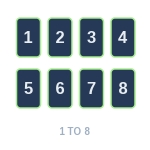
Each player starts with eight cards numbered 1–8.
2. Play a round
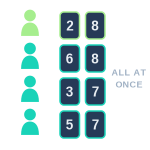
- Show two cards. Each player reveals two available cards.
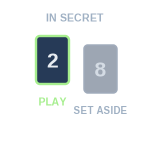
- Choose one. After seeing everyone’s pairs, secretly choose one of your two cards to play. The other is set aside.
- Reveal and cancel. Everyone reveals their chosen card. Any number played by two or more players is cancelled.
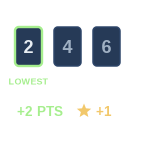
- Score a win. The lowest remaining card wins. Its owner scores points equal to the card’s number, plus one victory token. If all cards are cancelled, nobody wins.
What happens to your cards?
- Played card: Removed from your deck and cannot be used again.
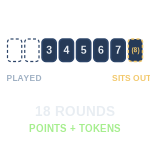
- Set-aside card: Sits out the next round, then returns to your hand for future rounds.
Every six rounds, all players receive a fresh deck of cards 1–8.
3. Win the game
Your final score is your total points from winning rounds, plus one point per victory token. The highest score wins.
Ties are broken by the most victory tokens, then by whoever won a round most recently.
Game modes and settings
Rounds: 6 rounds (one deck, the default) or 18 rounds (three decks, as on the show).
vs AI: Play with 3–7 players, including yourself. AI opponents have different strategies and difficulty levels, from choosing low cards to predicting opponents’ choices.
Online with friends: Play with 3–7 players. The host can fill empty seats with AI opponents.
Timers: You have 30 seconds to show your cards and 20 seconds to choose one. If time runs out, your two lowest available cards are shown, or the lower card is played.
Cards Left: Shows each player’s remaining cards, with cards sitting out for the current round in brackets. Turn it on with the Aid button; leave it off to track cards yourself.
Strategy
Keep your options open. Show a low card and a middle card so you can adapt after seeing everyone else’s choices.
Look for unique lows. Find the lowest number nobody else has shown. Playing it gives you a strong chance of winning.
Expect low-card clashes. Everyone wants the 1 and 2, so a unique 3 or 4 can be more valuable.
Track the decks. Use previously revealed cards to work out what opponents can still play.
Balance points and wins. Higher cards score more but are harder to win with. If you’re behind, consider risking a higher card for a bigger score.